

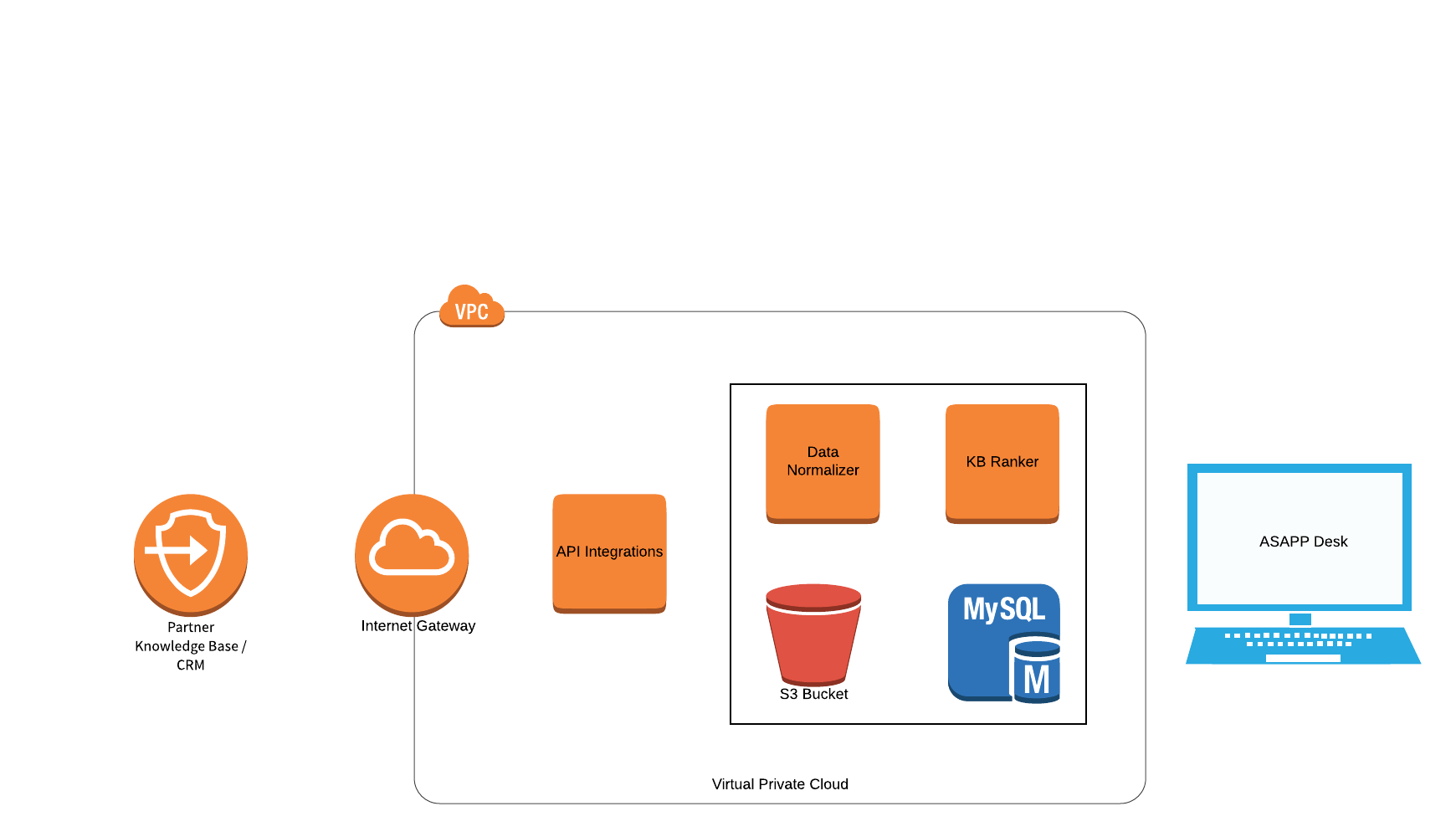
Integration
ASAPP can integrate with customer Knowledge Base systems or CRMs to pull data and make it available to Agent Desk. This is accomplished by a dedicated service, which can consume data from external systems that support standard REST APIs. The service layer is flexible enough to integrate with various industry standard Knowledge Base systems as well as in-house developed proprietary ones. The service programmatically retrieves new and updated articles on a regular basis to surface fresh and accurate content to agents in real-time. Data pulled from external systems is transformed into ASAPP’s standard format, and securely stored in S3 and in a database. Refer to the Data Storage section below for more details.Configuration
The service that integrates with customers is configuration driven so it can interface with different systems supporting different data formats/structures. ASAPP requires the following information to integrate with APIs:- REST endpoints and API definitions, data schemas and SLAs
- URLs, Connection info, and Test Accounts for each environment
- Authentication and Authorization requirements
- JSON schema defining requests and responses, preferably Swagger
- API Host that can handle HTTPS/TLS traffic
- Resource
- HTTP Method(s) supported
- Content Type(s) supported and other Request Headers
- Error handling documentation
- Response sizes to expect
- API Call Rate limits, if any
- Response time SLAs
- API Response Requirements
- Every ‘article’ should contain at least a unique identifier and last updated date timestamp.
- Hierarchical data needs to clearly define the parent-child relationships
- Content should not contain any PII/PCI related information
- Refreshing Data
- On a set cadence as determined and agreed upon by both parties
- Size of data to help in capacity planning and scaling